


Can Wireless Temperature Monitoring Reduce Food Waste and Costs?
You May Also Like:
- Top 5 Benefits of Wireless Temperature Monitoring Software
- Why Digital Record Keeping Is Your Best Defence During a Food Safety Investigation
- How accurate are wireless temperature sensors in commercial kitchens?
How Does Wireless Temperature Monitoring Help Prevent Food Spoilage?
Wireless temperature monitoring helps prevent spoilage by catching temperature drift early, so teams can act before food becomes unsafe or unusable. Instead of finding out too late, they get visibility while the issue is still fixable.
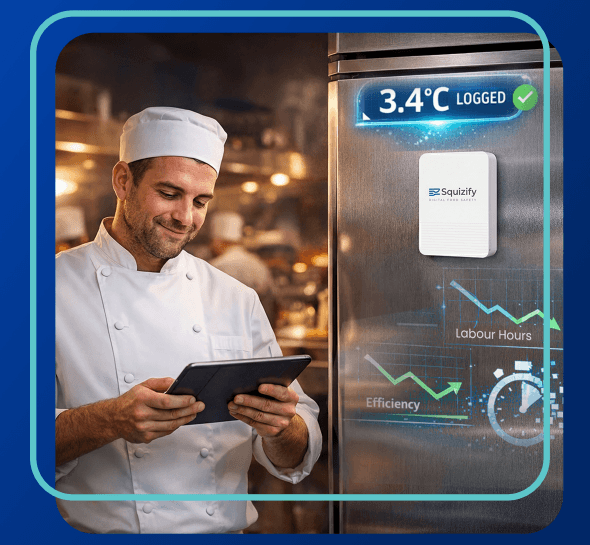
Compared with manual checks, real-time temperature monitoring provides continuous data, instant visibility, and fewer blind spots overnight or at weekends. In wireless temperature monitoring Australia deployments, this is especially useful for multi-site hospitality groups, supermarkets, aged care kitchens, and manufacturing cold rooms. Platforms like Squizify can combine sensors, automated logs, and auditing to keep records accessible 24/7 in a secure SaaS platform.
What does a wireless temperature monitoring system look like in day-to-day operations?
It usually follows a simple chain from measurement to action. The point is to turn temperatures into decisions, then store the proof automatically.
Typical flow in operations:
- Sensor reading in a fridge, freezer, cool room, or prep area
- Cloud sync to an online dashboard
- Alert triggered when thresholds are breached
- Corrective action taken and recorded
- Automated record keeping stored for audits
Hardware commonly includes temperature monitoring sensors in storage and prep areas, plus freight temperature monitoring for deliveries. Automated record keeping also reduces staff workload and improves accuracy compared to paper logs, especially across multiple shifts.
How do real-time alerts prevent small issues from becoming full spoilage events?
Alerts stop minor problems becoming major write-offs by shortening response time. Instead of waiting for the next manual check, they get notified as soon as temperatures move out of range.
Common triggers include a door left ajar, a failing gasket, defrost cycles running long, a power outage, or overloaded shelves blocking airflow. A simple playbook is to move stock, call maintenance, quarantine items if needed, and document actions for auditing. Faster response reduces discard volume and protects customer safety.
What Types of Food Waste Can Wireless Temperature Monitoring Reduce?
Wireless temperature monitoring can reduce three common waste types: spoilage from temperature abuse, precautionary disposal due to missing records, and over-ordering caused by low confidence in stock history. The biggest shift is reducing “unknown-history” waste with continuous evidence.
Across receiving, storage, display, prep, and transport, wireless temperature monitoring helps teams prove control and standardise performance. For multi-site operators, wireless temperature monitoring also reduces variation between locations using consistent checklists and automated logs.
Which spoilage scenarios does wireless temperature monitoring catch most often?
It most often catches failures that creep in between checks. These are the incidents that can spoil large volumes before anyone notices.
Typical scenarios include refrigeration breakdowns such as compressor issues, coil icing, or thermostat faults. Human error is also common, including doors left open, incorrect setpoints after cleaning, or poor stock rotation after deliveries. Peak-load strain matters too, like hot days, frequent openings during service, or overstocking that warms product.
How can online temperature monitoring reduce waste caused by paperwork and uncertainty?
Online temperature monitoring reduces waste because it removes gaps that force conservative decisions. If logs are missing, unclear, or obviously copied, teams often discard stock to avoid risk.
Automated record keeping supports verification through time-stamped readings, exception reports, and corrective action notes. With better auditing capabilities, checks are faster, disputes are fewer, and accountability is clearer. That can directly reduce disposal driven by uncertainty rather than actual temperature abuse.
How Much Money Can Businesses Save with Wireless Temperature Monitoring?
Savings usually come from four buckets: reduced product loss, reduced labour for manual checks, fewer emergency call-outs through early detection, and reduced compliance overhead. Wireless temperature monitoring also improves decision speed, which limits the size of losses when something goes wrong.
A simple way to estimate value is: average weekly discard cost × expected reduction rate, plus labour hours saved × wage rate, plus avoided incident costs. Hospitality benefits because of fast turnover, aged care and healthcare because compliance is strict, supermarkets because cold footprints are large, and manufacturing because batches can be high value. Squizify positions itself as a comprehensive compliance solution with tailor-made checklists, automated record keeping, and auditing capabilities to support operational excellence.
Where do the fastest cost savings usually come from?
Fast savings tend to be operational, not theoretical. They show up quickly when teams stop losing stock to unnoticed temperature drift.
Immediate wins usually include fewer spoilage events and fewer staff hours spent recording temps. Secondary wins come from trend data that supports better maintenance planning and fewer repeated breakdowns. Long-term wins come from standardised processes across sites through checklists and audit trails.
How do automated records and auditing capabilities reduce hidden compliance costs?
Compliance costs are often time costs and risk costs. Teams spend hours chasing paper, correcting gaps, and preparing for audits, especially when managers are not on site.
The risk cost is bigger: if they cannot prove control, they may dispose of stock unnecessarily or fail a compliance check. A secure SaaS platform with 24/7 accessibility helps managers and auditors retrieve the right evidence quickly, without relying on physical folders or one staff member’s memory.
How Does Wireless Temperature Monitoring Improve Stock Control and Efficiency?
Wireless temperature monitoring improves stock control by increasing confidence that food has been stored correctly, so it can be used closer to its intended shelf life within safety regulations. It also improves efficiency by cutting manual rounds and making ownership of corrective actions clearer.
Operationally, wireless temperature monitoring reduces duplication between shifts and sites, because the system becomes the shared source of truth. Many teams also pair monitoring with food label printing to improve date accuracy and consistency. Squizify supports this approach with customisable software via discovery calls and demo sessions, onboarding through “Book a Demo”, and 24/7 live chat support during rollout.
How does remote temperature monitoring change daily team workflows?
Remote temperature monitoring allows managers to verify checks without being on-site. When an alarm triggers, they can make faster decisions and assign actions immediately.
For multi-site groups, oversight improves because they can compare performance across locations and spot recurring issues. Automated alerts also reduce communication lag, replacing ad hoc messages with clear, time-stamped notifications that prompt a consistent response.
How can temperature monitoring solutions support better rotation and labelling discipline?
Stable temperatures reduce premature quality loss, which makes FIFO and FEFO easier to execute in practice. When a product holds its quality as expected, teams can rotate stock based on dates rather than guessing.
Food label printing helps reduce mislabelling and unclear use-by dates, which also reduces waste caused by confusion. Better documentation supports food safety programmes and makes auditing simpler because the records and actions align.
When Is Wireless Temperature Monitoring Most Valuable for Reducing Costs?
Wireless temperature monitoring is most valuable where the risk and consequences of temperature drift are high. That includes high-value stock, frequent deliveries, long operating hours, limited staff, and multiple cold assets across sites.
It matters most during overnight periods, weekends, and holiday shutdowns, when manual checks are weakest. In wireless temperature monitoring Australia rollouts, wide geographic distribution makes consistent oversight harder without centralised tools. Wireless temperature monitoring also helps businesses take a practical next step: identify waste sources, choose assets for sensors, define thresholds, and ensure the platform supports automated records, auditing, and easy access.
Which businesses benefit most from wireless temperature monitoring systems?
Hospitality benefits due to frequent door openings and fast-moving perishables. Supermarkets benefit because one failure can affect many fridges and freezers at once, creating large waste.
Aged care, healthcare, and child care benefit because food safety oversight is strict and audit readiness is essential. Manufacturing and fuel sites can benefit where controlled environments and distributed operations require consistent compliance across locations.
What should they look for when choosing a wireless temperature monitoring system?
They should prioritise reliable sensors, real-time temperature monitoring, clear alerts, and long-term data retention for online temperature monitoring. It should also support automated record keeping, strong auditing capabilities, role-based access, and a secure SaaS platform with 24/7 accessibility.
Implementation matters too, including customisation, onboarding support, and ongoing help such as live chat support. For many operations, scalability is essential so they can add assets and sites easily, and include freight temperature monitoring if deliveries are a risk point.
If reducing waste and controlling costs is a priority, they should map their highest-risk cold assets and book a demo to validate the workflow before rolling out across every site.