


50°C at midnight: what France’s supermarket fridge attack teaches every food business
You May Also Like:
- Can Wireless Temperature Monitoring Reduce Food Waste and Costs?
- Top 5 Benefits of Wireless Temperature Monitoring Software
- Why Digital Record Keeping Is Your Best Defence During a Food Safety Investigation
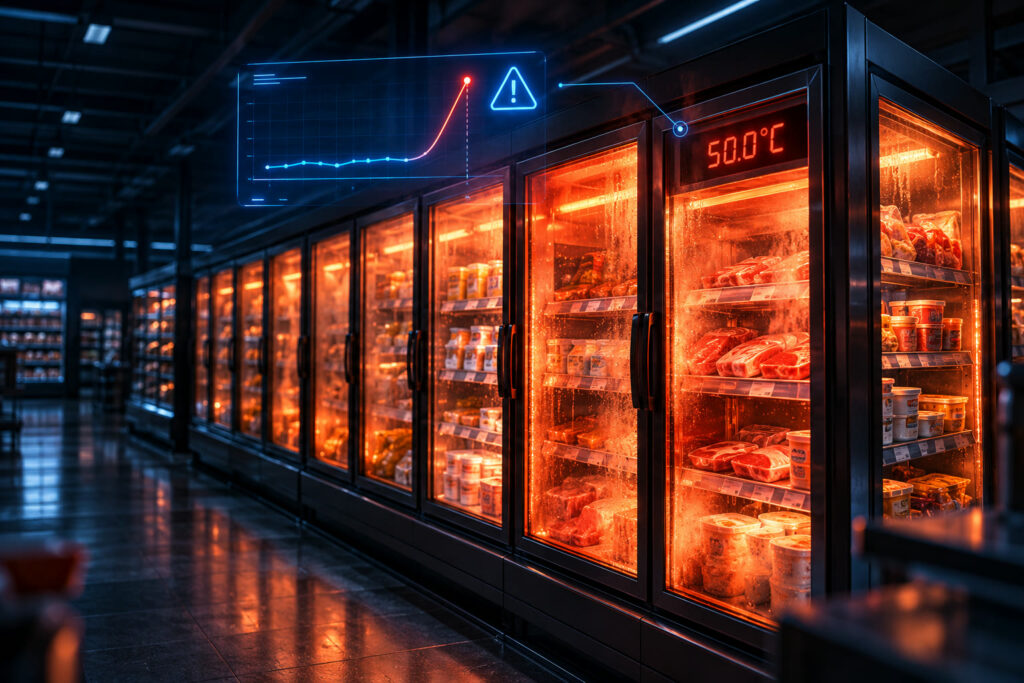
On the night of Sunday 11 October 2026, hackers got into the refrigeration controls of supermarkets across France. They didn’t break a single door. They changed the settings.
By morning, hundreds of stores had lost their fresh and frozen stock, several had caught fire, and one retailer was counting losses in the tens of millions of euros. It’s one of the clearest warnings yet that food safety risk now includes the systems we use to protect it.
The numbers
- 50°C: the temperature hackers forced fridges and freezers to.
- 6 hours: how long Intermarché’s affected fridges stayed at that heat, overnight.
- Hundreds of stores: hit across at least five major French chains, with reports of attacks in Spain, Portugal, Poland, Germany and Belgium.
- Tens of millions of euros: Intermarché’s estimate of its losses in a single day.
The night the fridges turned against the food
Fridges and freezers built to keep food at 5°C or below were pushed to 50°C. Some units were forced into defrost cycles. In several stores, fires broke out.
Les Mousquetaires, owner of Intermarché, said about 150 of its stores ran at 50°C for six hours overnight. By morning, there was no decision left to make. Every fresh and frozen product in the affected units had to be thrown out. It wasn’t safe to sell and it wasn’t safe to donate.
Carrefour lost 80 supermarkets. Cooperative U had more than 100 outlets affected. Monoprix and E.Leclerc stores were hit too.
“Targeting equipment essential to the preservation of fresh products and to the food supply of the French people is of extreme gravity and is unprecedented.”
Dominique Schelcher, CEO, Cooperative U
“Tens of millions of euros nationwide in a single day.”
Thierry Cotillard, CEO, Intermarché, on the cost of the attack
How it happened
France’s national cybersecurity agency traced the attack to a weakness in refrigeration management software. The manufacturer said the affected units were “running outdated firmware” (the built-in software that runs the equipment).
That is the uncomfortable part. These weren’t exotic systems. They were ordinary controllers doing an ordinary job, in thousands of stores, connected to the internet for convenience.
“Attackers do not necessarily need to hack individual fridges. Once inside, they can potentially change temperature set points across many locations at once.”
Professor Ryan Ko, Director, University of Queensland Cyber Research Centre, speaking to the ABC
No one is immune
It would be easy to call this a French problem. It isn’t.
Australian experts have already warned that large, centrally managed chains here are exposed in the same way. Refrigeration controllers often stay in service for a decade or more, long after their software was designed.
“Operational technology systems are often designed to operate for many years.”
Dr Rahat Masood, Senior Lecturer in Computer Science, UNSW
“We have connected infrastructure that is live on the internet, and that can be hacked. It’s a new reality.”
Steven Lachance, cybersecurity analyst
Lachance called the attack “a global wake-up call” and warned that without action, “it’s just going to keep happening.”
Hackers aren’t the only threat either. A failed compressor, a tripped circuit, a door left open overnight or a power outage can all do the same damage. The French attack simply showed how fast and how widely it can happen at once.
“The pace of technology means bad actors can now strike deeper and faster than ever before. What happened in France could happen anywhere. Having the right monitoring in place is the difference between catching a problem in minutes and losing tens of millions of dollars, along with your customers’ trust in your brand.”
Daniel McDouall, Co-founder and CEO, Squizify
The clock starts the moment the temperature rises
Food safety comes down to time and temperature. In Australia, the 2-hour/4-hour rule sets out what to do with potentially hazardous food that has been between 5°C and 60°C:
- Under 2 hours: refrigerate it or use it straight away.
- 2 to 4 hours: use it straight away. It can’t go back in the fridge.
- Over 4 hours: throw it out.
Intermarché’s fridges ran at 50°C for six hours. By the time anyone opened the doors in the morning, the four-hour line was long gone. The stock was lost before anyone knew there was a problem.
The lesson isn’t that disaster can always be prevented. It’s that how fast you find out decides what you can save.
Minutes, not morning
Picture the same night two ways.
Without monitoring: Fridges start warming at midnight. Nobody knows. Staff arrive at 6am to warm cabinets and spoiled stock. Everything goes in the bin. The investigation starts after the damage is done.
With independent monitoring: Fridges start warming at midnight. Within minutes, sensors detect the rise and alerts go out to the people who need to act. The duty manager moves stock to unaffected cold storage. Maintenance isolates the faulty units. IT starts looking for the cause. The 2-hour window is still open. Stock is saved, risk to customers is contained, and there’s a timestamped record of exactly what happened and what was done.
Same attack. Very different morning.
Why independence matters
In France, the system that controlled the fridges was the same system that was compromised. If the fridge’s own controls are lying, you can’t rely on them to raise the alarm.
Squizify’s sensors run independently of the refrigeration equipment. They don’t take instructions from the fridge, and they don’t rely on the fridge’s software to report a problem. They simply measure the temperature and report it.
That makes them a separate layer of protection. If the fridge controls fail, whether through a hack, a fault or human error, a second set of eyes is still watching.
The right alert, to the right people, at the right time
A warning only helps if it reaches someone who can act. Squizify sends alerts to the people who need them, and escalates if the first person doesn’t respond:
- Store and site managers, to protect stock on the spot.
- Maintenance and facilities teams, to get equipment checked and repaired fast.
- IT and security teams, when the pattern points to something bigger than one broken fridge.
- Senior and regional management, when several sites are affected at once, as they were in France.
When one fridge fails, it’s a maintenance job. When 150 stores fail at the same moment, it’s a business crisis. Seeing that pattern early is what turns a crisis back into a problem you can manage.
Built for global food safety
Squizify is an operational assurance platform built on HACCP principles, the internationally recognised method for identifying and controlling food safety hazards. It brings together real-time temperature monitoring, digital food safety checks, corrective action records and reporting in one place.
It’s used by multi-site food businesses across Australia, New Zealand, Thailand, Japan and the United States. Every reading, alert and corrective action is timestamped and recorded, so when an auditor, regulator or insurer asks what happened, the answer is already there.
Five questions every food business should be asking now
- If our fridges failed at midnight tonight, how long would it take us to find out?
- Does our temperature monitoring depend on the same system that controls the equipment?
- Who gets the alert, and what happens if they don’t respond?
- Would we know straight away if several sites failed at the same time?
- Could we prove to an auditor what we did and when?
If any answer is “we’re not sure”, now is the time to fix it. Not after it happens.
The takeaway
The French attack wasn’t a failure of refrigeration. It was a failure of visibility. The fridges did what they were told. Nobody was told what the fridges were doing.
Good food safety systems don’t stop every incident. They make sure that when something goes wrong, you know in minutes, not hours. That gap is the difference between saving your stock and throwing it all away.
Want to see how independent monitoring works across your sites? Talk to the Squizify team.
Sources: ABC News, 13 October 2026. Reuters via TimesLive, 12 October 2026. Al Jazeera, 13 October 2026. The Cool Down.