


The night the fridges were hacked
You May Also Like:
- 50°C at midnight: what France’s supermarket fridge attack teaches every food business
- Can Wireless Temperature Monitoring Reduce Food Waste and Costs?
- Why Digital Record Keeping Is Your Best Defence During a Food Safety Investigation
What Europe’s refrigeration cyberattacks teach every food business about independent temperature monitoring.
On the night of 11 October 2026, someone turned up the heat inside the fridges and freezers of about 700 French supermarkets. The stores were closed and nobody was there to see it.
By morning, cabinets full of chilled and frozen food had been sitting at up to 50°C for hours. At least 15 fires had started. Whole aisles of stock went in the bin.
The refrigeration systems raised no alarm. They couldn’t. The attackers were in control of the system that raises it.
What happened
The targets were the refrigeration controllers that run display cabinets, cool rooms and freezers. Many were reachable from the internet, unpatched, or still using default passwords. The attackers logged in and changed the defrost settings to push temperatures up, with the food still inside.
The stores belonged to some of France’s biggest chains, including Intermarché, Carrefour, Coopérative U, Monoprix and E.Leclerc. Retailers reported millions of euros of spoiled food (ABC News, Al Jazeera).
On 2 November, a second wave hit more than 100 sites in other European countries, including Belgium, Estonia, Ireland, Luxembourg and Sweden. Three French blood service facilities were targeted as well.
In the United States, the FBI, CISA and four other agencies have since warned that industrial refrigeration and cold chain systems worldwide may be targets (Supermarket News).
Why nobody knew until morning
In most stores, the refrigeration controller does two jobs. It runs the equipment, and it raises the alarm when temperatures go wrong. Take over the controller and you take over the alarm.
So the fridges warmed for hours with nothing to say so. Staff found out when they opened up.
The blood service is the exception worth studying. Its facilities were targeted too, and no blood was lost. Alarms reached staff in time, and they moved product to other cold storage.
It was the same kind of attack. The supermarkets lost aisles of stock and the blood service lost none. The difference was a warning that reached a person.
The lesson: keep the monitor separate from the machine
This is not only a cybersecurity story. A failed compressor, a tripped breaker or a door left open overnight ends the same way, with warm food and no warning.
The fix is the same too. The thing that measures temperature should be separate from the thing that controls it.
The US agencies’ advice to operators included this line: “Set safe temperature limits, and make sure alerts reach the right people.” We’d add one thing. Those alerts should come from a system the refrigeration controller can’t silence.
The same night, with Squizify
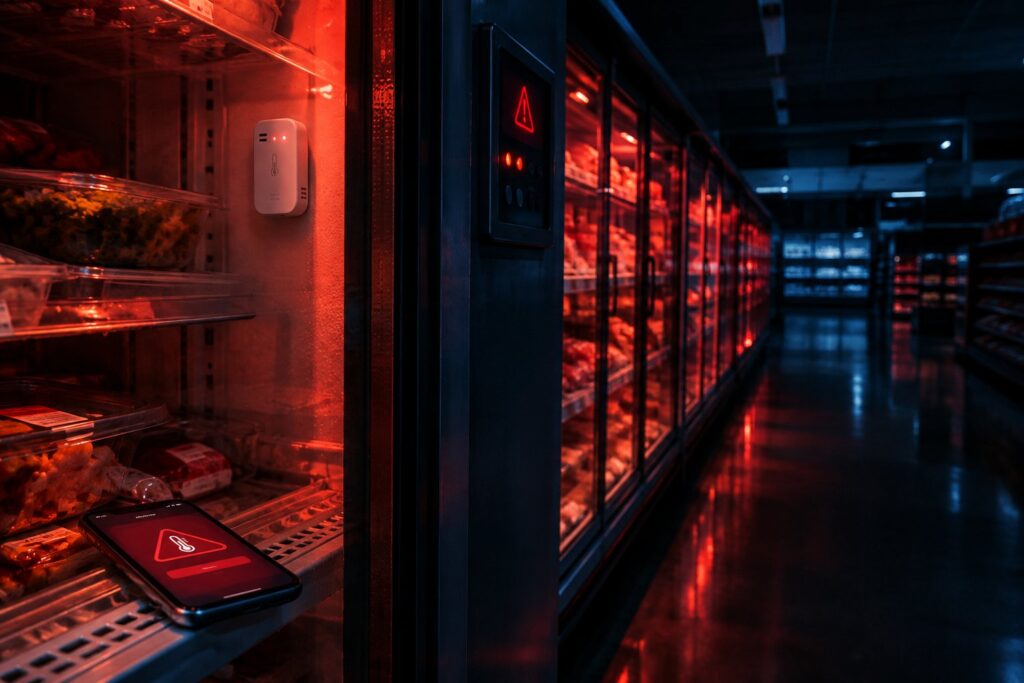
Squizify’s Continuous Temperature Monitoring uses its own wireless sensors inside each fridge, freezer and cool room. They are not connected to the refrigeration controller. They measure temperature and humidity, and they cannot change how the equipment runs.
Here is how the night of 11 October plays out with that in place.
- The sensor sees it. The temperature climbs past the limit head office has set. The controller says nothing. The sensor reports anyway.
- An alert goes out. The store team gets it by push notification, SMS, email or WhatsApp.
- It escalates until someone acts. If nobody responds, the alert climbs on a timer: store, area manager, regional manager, head office. Nothing depends on someone remembering to ring someone.
- A corrective action opens. It has an owner and a clock. The team moves stock to a safe unit and isolates what can’t be saved.
- Head office sees the whole network. One warm fridge is a breakdown. The same alert from hundreds of stores in one night is something else. Reporting across every site shows which it is.
- The record is kept. Every reading, alert and action is time-stamped. You know which units were out of range and for how long. That supports the keep-or-discard call, the insurance claim and the conversation with the regulator.
If a sensor goes quiet, that raises an alert as well.
No monitoring system stops an attacker getting into a controller. What it does is turn a morning discovery into a night-time response, while there is still stock to save and customers to protect.
Five questions to ask about your own cold chain
- If a fridge fails at 2am, who finds out, how, and when?
- Is your temperature alarm part of the refrigeration controller, or separate from it?
- If the first person doesn’t respond, who is told next, and how long does that take?
- Can head office see temperatures across every site in one place?
- Could you show an insurer or an inspector exactly how long each unit was out of range?
If any answer is “we’d find out in the morning”, you have the same gap those 700 stores had.
See it for yourself
Squizify helps multi-site food businesses keep food safe and prove it, from supermarkets and convenience stores to quick service restaurants and hotels.
Book a demo at squizify.com. We’ll show you independent temperature monitoring, alerts and escalation working together, and what your team would see at 2am.